
You have grown past six figures, proven your offer, and built a team you trust.
Clients come in, the work is good, and then.....quietly, some of them don't come back.

You have probably blamed yourself. Maybe the offer needs refining. Maybe the marketing isn't strong enough. Maybe you need to show up more on social media or run better ads or hire someone to fix the funnel. So you invest in acquisition, you know the drill: more visibility, more leads, more new clients. While you are focusing on that, the ones you already earned slip out the back door without explanation.
Here is what most growth-stage service business CEOs have never been told: the clients who didn't come back were almost never leaving because of your offer. Research from NewVoiceMedia shows that 68% of clients leave because they felt unappreciated.
That is not a marketing problem, that is a relationship problem and it has a very specific fix that most business advice completely misses.
This article is about that fix. And it starts with understanding the difference between two terms that sound similar but produce completely different outcomes: customer experience and client relationships.
What Customer Experience Actually Is, And Who It Was Built For
You have probably heard the term customer experience, or CXm used in business conversations, articles, and advice you have come across while trying to figure out your retention problem. It sounds relevant. It sounds like exactly the thing you need to fix.
But customer experience as a formal discipline was not built for businesses like yours.
CX emerged from enterprise. Basically large companies managing the complexity of serving thousands or millions of customers across dozens of channels, systems, and departments. It is fundamentally a systems problem at that scale. How do you create consistency when no single person will ever experience the full journey? How do you measure satisfaction across a customer base too large to speak to individually? How do you reduce friction in a process so complex that no one person fully understands it?
The tools the traditional CX world developed — journey maps, satisfaction surveys, touchpoint audits, experience design frameworks — are genuinely useful answers to those questions. For a company with 50,000 customers and a 200-person team, those tools are essential.
But here is the problem.
Your business does not have 50,000 customers. You have 50. Or 80. Or 150. You do not have a 200-person team. You have three to ten people who wear multiple hats, know most clients by name, and build relationships that are personal — t transactional.
When you take tools designed for enterprise complexity and apply them to a business built on personal relationships, you end up optimizing the wrong thing entirely.
You start mapping the journey when you should be examining the relationship. You start measuring satisfaction scores when you should be asking why your best clients quietly stopped coming back. You start fixing the process when the real problem is that nobody on your team has ever been formally aligned on what a strong client relationship looks like in your specific business.
The Difference That Changes Everything
Here is the clearest way I know to explain the distinction.
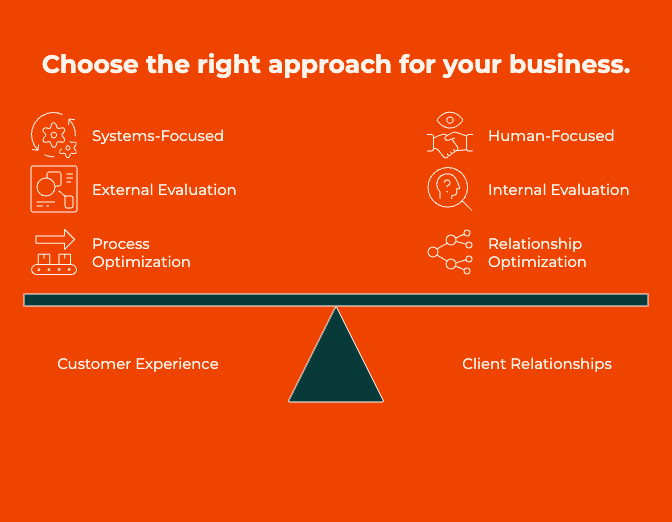
Customer experience is about what happens. Client relationships are about how it feels.
Customer experience asks: did the client receive what they were promised at each stage of the journey? Client relationships ask: did the client feel seen, valued, and remembered throughout the process?
Customer experience is evaluated from the outside, from the perspective of someone auditing the system. Client relationships are evaluated from the inside, from the perspective of someone who trusted you with their business and their money and is now deciding whether to do it again.
Customer experience can be optimized without a single human conversation. Client relationships cannot.
This distinction matters enormously for service businesses because your product is not a widget moving through a supply chain. Your product is the expertise, attention, and care that your team delivers to another human being. The relationship is not a byproduct of the experience, the relationship is the experience.
When a client does not come back after working with you, they are almost never leaving because a touchpoint was inefficient. Research from NewVoiceMedia shows that 68% of clients leave because they felt unappreciated. Not underserved. That is a relationship failure and no journey map in the world will fix it.
Why the CX Framework Falls Short for Service Businesses
I want to be precise here because this is not a criticism of CX as a discipline. It is a recognition that tools are designed for specific contexts. When you use the wrong tool for the context, the results are predictably disappointing.
There are three specific ways the standard CX framework falls short for growth-stage service businesses.
It focuses on the CEO instead of the team.
Most CX consulting engagements work with the business owner or the leadership team to identify problems and design solutions. The assumption is that if the CEO understands the gaps and has a good strategy, the experience will improve. In large enterprises, that logic works because there are managers and systems between the CEO and the customer.
In a growth-stage service business, the CEO is often not the person building the client relationship day to day. It is the account manager, the onboarding coordinator, the project lead, the person who answers the emails. If those people are not part of the diagnosis and the solution, the strategy the CEO walks away with will not survive contact with reality. The CEO improves. The team stays the same. The client relationship stays the same.
It treats the problem as structural when it is often cultural.
CX frameworks are excellent at identifying structural problems: broken processes, missing touchpoints, inconsistent communication sequences. What they are not designed to diagnose is the cultural problem underneath those structural symptoms: a team that has never been formally aligned on what a strong client relationship looks like in this specific business.
When team members have never had a shared conversation about what great looks like, the client experience varies depending on who picks up the phone that day. That variability is not a process problem. It is a relationship culture problem. And it requires a different kind of intervention than a journey map.
It delivers a plan when what the business needs is trained people.
The typical CX engagement ends with a deliverable — a report, a roadmap, a set of recommendations. That deliverable is valuable. But a plan without trained people to execute it is just a document. The gap between the strategy and the outcome is almost always the team's capability and confidence to deliver the relationship the CEO has designed on paper.
This is the fundamental limitation of advising the CEO without training the team. The CEO gets smarter. The team gets a new process to follow. But the relationship habits, such as how the team shows up with clients, how they handle difficult moments, how they create the feeling of being genuinely valued — those do not change because the CEO read a good report.
What the Relationship Lens Changes
When you approach client retention through the lens of relationship rather than experience, three things shift immediately.
The diagnosis gets more precise.
Instead of asking "where is the journey breaking down?" you ask "where is the relationship feeling thin?" Those are different questions that produce different answers. Journey breakdowns are often structural — a missing follow-up, a delayed response, an unclear deliverable. Relationship breakdowns are often human — a client who felt like a transaction, a team member who didn't know the client's name, a moment where reassurance was needed and silence showed up instead.
The relationship question surfaces the real problem faster because it speaks the language the client is actually experiencing. Clients do not leave your business thinking "that onboarding touchpoint was suboptimal." They leave thinking "I didn't feel like they really cared about my success."
The solution involves the whole team.
If the problem is a relationship problem, the solution has to involve the people who build the relationship. That means the team, not just the CEO. It means sitting in a room together and asking: what does a strong client relationship look like at each stage of our journey? Who owns which moments? What is the standard we are all committing to? What happens when the CEO is not in the conversation?
That conversation is the work. Not a new process added to the operations manual. A shared team commitment to a relationship standard that is documented, owned, and sustainable.
The outcome is durable.
When the CEO is the only person who understands the relationship strategy, the relationship depends on the CEO's attention to hold. The moment she steps back to focus on growth, to take a vacation, or to hire new team members — the client experience degrades because it was never built into the team's capability. It was built into her personal bandwidth.
When the team owns the relationship standard, the outcome is durable. A new hire can be onboarded to the standard on Day 1. A team member can handle a difficult client moment without escalating to the CEO. The relationship holds whether or not the CEO is in the room because the team knows what great looks like and has committed to delivering it.
That durability is the difference between a business that scales and a business that stays dependent on its founder.
What This Looks Like in Practice
Let me make this concrete with a pattern I see consistently in growth-stage service businesses.
A CEO builds a strong offer, earns her first clients through reputation and referral, and delivers excellent work. She is deeply involved in every client relationship ie: she knows their names, their goals, their concerns. Clients stay. They refer others. The business grows.
Then she hires. She brings on a team member to handle client communication. Another to manage delivery. Maybe a contractor or two for specialized work. She steps back from the day-to-day client interactions because that is what growth requires.
And quietly, the relationships start to thin.
Not because the team is incompetent, but because the relationship standard that lived inside the CEO's instincts and attention was never made explicit, never transferred to the team, and never built into the way the business operates without her.
Clients start to feel like they are being handled rather than valued. Response times that used to feel personal now feel transactional. The warmth that defined the early client experience has faded enough that when the engagement ends and the renewal conversation comes, the client finds a reason to explore other options.
The CEO runs more ads. She hires a marketing consultant. She updates her funnel. She brings in new clients to replace the ones who quietly left. The acquisition treadmill accelerates.
What she actually needs is to make the relationship she built personally into something the team can deliver consistently without her holding it all together.
That is not a customer experience problem. That is a client relationship problem. And it has a specific solution.
The Three Questions That Reveal Which Problem You Have
If you are a growth-stage service business CEO reading this and wondering whether your retention challenge is an experience problem or a relationship problem, ask yourself these three questions.
01
when a client doesn't come back, do you know which moment in the relationship was the turning point?
If you cannot name the moment, you do not have a data problem. You have a relationship visibility problem. The team members who were closest to that client at that moment may know exactly what happened. The question is whether they have ever been asked.
02
if you were removed from the client relationship entirely for 30 days, what would change?
Be honest. Would the quality of the relationship hold? Would clients feel the same level of care, attention, and connection? Or would something quietly degrade — response times, tone, follow-through, the feeling of being remembered? If the answer is that something would degrade, the relationship is being sustained by your personal attention rather than by a team standard. That is the dependency that FlowTribe is designed to break.
03
has your team ever had an explicit conversation about what a strong client relationship looks like in your business?
Not a training on your processes. Not an onboarding document that covers the logistics. A real conversation where every team member sat together and said: this is what great looks like at every stage of the client journey, this is the standard we are all committing to, and this is who owns each moment. If that conversation has never happened, the relationship standard is implicit.
If you answered honestly and found yourself recognizing the pattern, you are not dealing with a customer experience problem that a journey map will fix. You are dealing with a client relationship problem that requires training the team that delivers the relationship every day.
Where to Go From Here
The first step is always diagnosis. Before you can fix the relationship, you need to see it clearly through data that shows you where the relationship is actually breaking down.
FlowLab is Fierceified's free diagnostic tool that maps your client journey and identifies your priority relationship stage — the place where improving the relationship will have the greatest impact on whether clients stay, return, and refer others. It takes about 30 minutes and it will show you more about the state of your client relationships than most CEOs have ever seen in one place.
You can start FlowLab at flowlab.fierceified.agency.
If you are ready to go further — to bring your team into the diagnosis, design the improvement together, and build the ownership structure that makes the relationship sustainable — FlowTribe is the engagement that does exactly that. Two weeks. Four sessions. Your whole team in the room. One relationship transformation that holds after we leave.
The client relationships your business needs to grow are already within reach. They are sitting in the relationships you have already started — with clients who came in, got great work, and left quietly because the relationship was not strong enough to hold them.
That is the problem worth solving. And it starts with seeing it for what it actually is.